 |
|
Tracker Tech Notes
Feature Lists:
Trackers:
- Sturdy waterproof box that is easy to mount on power carts and gators.
- Possibly 3D printed, with drywall screw mounting tabs, or day pack / zip tie strap slots.
- Ideally be slim like a cell phone with the connectors on the top or bottom edges.
- Runs off a wide range of input voltages as some of our power carts are 12V and others are 24V.
- Uses a low cost and efficient DC-DC converter for this.
- Has an Anderson connector charging port.
- Self contained battery.
- This allows it to run for a while even if the unit is accidentally disconnected.
- Simple charge circuit so it is not overcharged.
- Should work in the hot sun or in an engine compartment in the summer.
- Robust non-breakable antennas.
- Use a popular connector so we have access to many low cost antennas.
- Option to screw the antennas to the box, or mount them up to 6 feet away.
- At least one watt RF output, optionally more.
- Possibly have a modem chip / firmware that can do multiple speeds. We might need them someday.
- Serial port to receive data from the power carts battery monitor.
- This is how we'll get SOC, current use, battery temperature, etc...
- Ability to receive and act on commands, such as small tuning updates.
- Firmware Over-The-Air (FOTA) would be nice but optional.
- Non volatile storage for tuning parameters.
- Prefer a small flash partition, but NV-Ram could work.
- GPS features:
- Consider GPS / GLONASS + Dual band GPS devices. eg. L1, G1, and L2, L5, G3.
- "It will help with tree cover and nearby tall buildings."
- WAAS would be good too, or National Differential GPS (DGPS) service.
- Consider Assisted GPS A-GPS, A-GLONASS, perhaps send updates to trackers via internet.
- Phantom powered antenna 5V?
- This helps with GPS lock under trees.
- Asset Tracker project below uses Max2674 for Active antenna switching.
- Others: China's: BeiDou (BDS), Europe's: Galileo 2020ish
- Consider GPS / GLONASS + Dual band GPS devices. eg. L1, G1, and L2, L5, G3.
- Very low power sleep mode with fast wake up, (think GPS lock) for all components.
- You can use this to turn it "off" in software.
- No actual power switch, except perhaps inside the box next to the internal battery connector.
- USB data and charging port.
- A push button to request status, or ask for a transmit.
- A Green / Red LED to show status.
- Lay out the Circuit board with marked areas for optional sub assemblies that are not necessarily populated.
- So the GPS may be optional.
- Have an optional Bluetooth link so it can work with cell phones like the Mobilinkd.
- Optional display and keypad for simple standalone use.
- Optional mike and speaker for emergency communications or PA type announcements to folks that don't have radios.
- SW selectable power setting
- Siri type smart phone app that tells you where the unit is.
- Low cost!

- It could just be a Cell phone App that sends location date to the database to be displayed.
- GPS Logger for Android.
Map Server:
- Can serve a web page for cell phone use.
- Should be able to center the map on a given call sign.
- Ability to filter APRS stations by type.
- Ability to show telemetry by clicking on an icon.
- A pop up window with a list of power carts sorted by charge state.
- Show weather it's charging or not.
- Perhaps a way to get a station to temporary send many packets at a higher rate.
- Have dead reckoning or speed estimation based on last packet.
- Can we have animated icons in YAAC?
APRS:
- Main articles
- Good list of products: http://info.aprs.net/index.php?title=Hardware
- List of SW modem projects: http://www.pe0sat.vgnet.nl/decoding/software-modems/
- Write ups on different baud rates:
1200 Baud:
This is the most popular mode for general packet radio, and APRS in particular. It is based on the Bell 202 modulation standard, which uses two distinct tones. The tones are 1,200 Hz for Mark and 2,200 Hz for space (1,000 Hz shift). The data is differentially encoded with a NRZI pattern, where a data zero bit is encoded by a change in tones and a data one bit is encoded by no change in tones.2400 Baud:
Initially we could probably run our tracking network just fine using 1200 baud, which is the most popular speed for APRS around the world. Though there are other speeds used, such as 9600 baud, which is eight times faster, but requires fancier radios. 2400 baud is the next step up from 1200 and requires almost no extra work to get. Since we get to set the standard for our own network, it doesn't matter that this speed is not that popular in most other APRS systems. Of course, we will have to test it to see if it is just as reliable as 1200 baud, and ideally we should use a modem chip, and or firmware that can do both so we can switch back and forth under software control. Some products and specs for other 2400 baud APRS systems:- MFJ-2400
- Chip: EXAR XR-2123 PSK Modem.
- Docs: https://www.mfjenterprises.com/Downloads/index.php?productid=MFJ-2400&filename=MFJ-2400.pdf&company=mfj
- AEA PK232-2400
- Seems to use discreet parts.
- Docs: https://www.dl0bn.de/dc7xj/Anleitungen/AEA%20PK-232%20TechnicalReferenceManual.pdf
- Schematics are in appendix C (p75), see page 81 for a block diagram.
- Kantronics KPC-2400
- Docs: https://www.dl0bn.de/dc7xj/Anleitungen/Kantronics%20KAM_KPC-1-2-4-2400_Installation%20Manual.pdf
- Schematic is on page 50 but the IC's are not documented very well.
- DIY: Use a TCM3105 modem chip modified with a 8Mhz crystal for the modem clock, and uses a 2165 and 3970 Hz tone pair.
- Or just use a fast MCU or DSP. It turns out that most TNCs these days, don't use modem chips at all.
9600 Baud modulation (Not for us):
Schematics to cut and paste from:
- DRA818V board:
- HamShield for Arduino: https://www.enhancedradio.com/collections/hamshield-and-accessories/products/hamshield
- https://github.com/EnhancedRadioDevices/HamShield1
- Basied on the Auctus AT1846S, (Most recent model of the RDA1846)
- Check out the MINI!: https://www.enhancedradio.com/collections/hamshield-and-accessories/products/hamshield-mini
- TNCs:
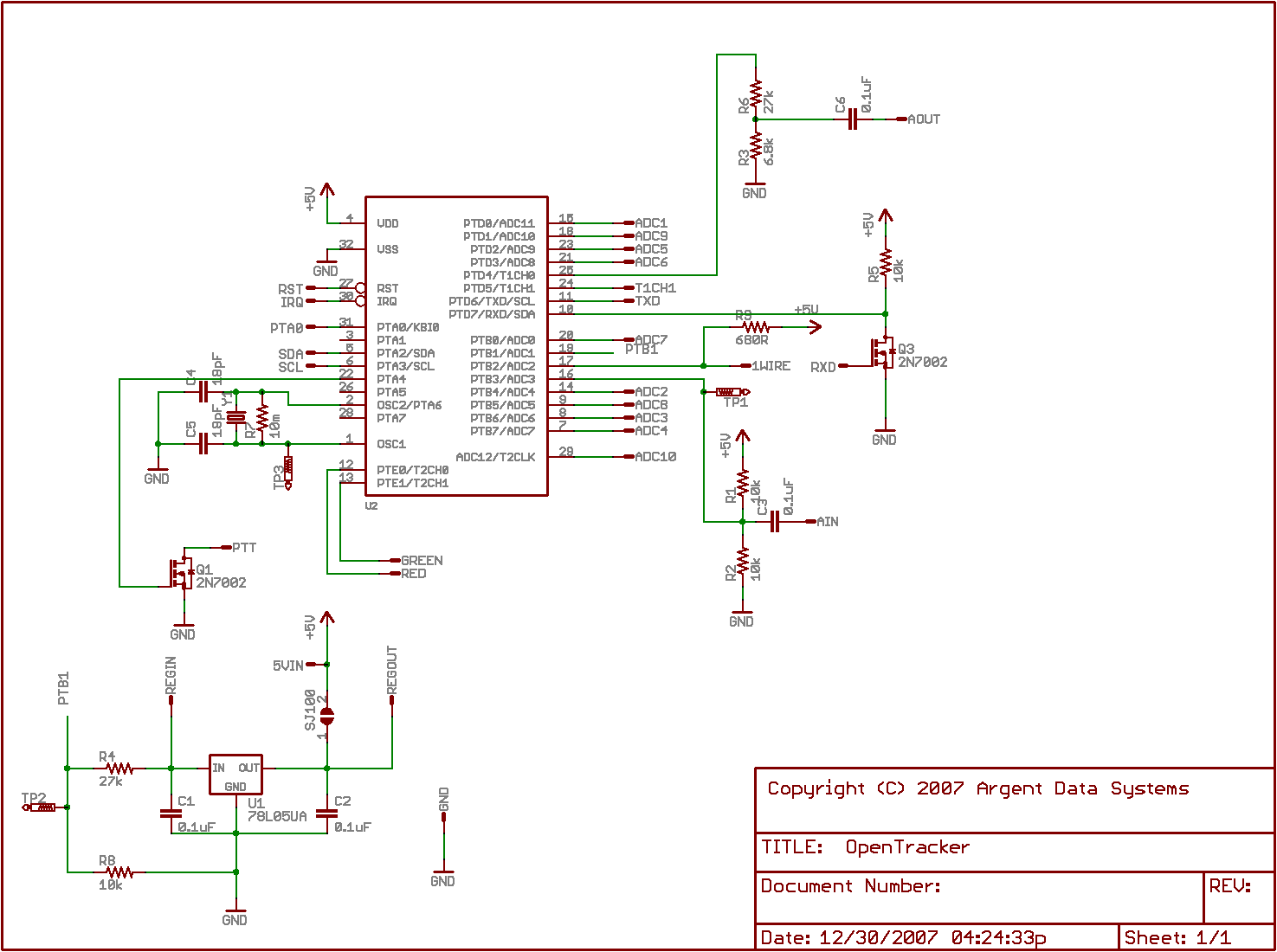
- OpenTracker + (OT1+): https://www.argentdata.com/products/otplus.html
- This is the precursor to the BeRTOS one below
- Schematic: https://www.argentdata.com/support/ot1plus-smt-1_5-schematic.xxx
- Uses a Freescale HC908JL16, or a MC9S08AW32 for the RT version: https://www.nxp.com/docs/en/data-sheet/MC68HC908JL16.pdf
- OT1+ Wiki: http://wiki.argentdata.com/index.php?title=OpenTracker%2B
- Couldn't find any source code archives, darn...
- BeRTOS based: https://sites.google.com/site/ki4mcw/Home/arduino-tnc
- This was the precursor to the Mobilinkd ones below. Source is at the bottom of the above page.
- BeRTOS: http://www.bertos.org/
- Related Project: https://michaldemin.wordpress.com/2012/02/27/cheap-afsk-tnc/
- Source: https://github.com/robots/APRS
- Mobilinkd TNC2: http://www.mobilinkd.com/wp-content/files/Kiss_TNC_SMD-2_0_9_schem.pdf
- Uses a ATmega328PB: https://www.sparkfun.com/datasheets/Components/SMD/ATMega328.pdf
- Search on: active supply current
- Firmware: https://github.com/mobilinkd/tnc1
- Uses a ATmega328PB: https://www.sparkfun.com/datasheets/Components/SMD/ATMega328.pdf
- Mobilinkd TNC3: https://s3.amazonaws.com/mobilinkd/TNC3/TNC3-schematic.pdf
- Uses a STM32L433XX MCU: https://www.st.com/en/microcontrollers/stm32l433cc.html
- Features: https://www.st.com/content/ccc/resource/sales_and_marketing/presentation/product_presentation/4a/c2/01/20/3d/e6/4c/08/stm32l4_marketing-pres.pdf/files/stm32l4_marketing-pres.pdf/jcr:content/translations/en.stm32l4_marketing-pres.pdf
- Firmware: https://github.com/mobilinkd/tnc3-firmware
- Shields based on STM32L4:
- https://github.com/stm32duino/Arduino_Core_STM32#boards-available
- https://www.youtube.com/watch?v=6eUqxjBL_wI
- NUCLEO-L433RC-P: https://www.arrow.com/en/products/nucleo-l433rc-p/stmicroelectronics
- Butterfly: http://www.electronics-lab.com/butterfly-ladybug-stm32l4-based-arduino-programable-development-boards/
- Based on the Dragonfly (same FF): https://www.tindie.com/products/onehorse/dragonfly-stm32l4-development-board/
- The 0.7 in x 1.4 in. form factor is a direct copy of the Teensy, which (I think) is Arduino mini compatible.
- https://www.tindie.com/products/TleraCorp/butterfly-stm32l433-development-board/
- https://github.com/GrumpyOldPizza/arduino-STM32L4
- Based on the Dragonfly (same FF): https://www.tindie.com/products/onehorse/dragonfly-stm32l4-development-board/
- VA2EPR-TNC: https://github.com/tcort/va2epr-tnc
- OpenTracker + (OT1+): https://www.argentdata.com/products/otplus.html
- Others:
- Asset Tracker: https://hackaday.io/project/25790-asset-tracker
- http://blog.oshpark.com/2017/07/30/asset-tracker/
- Uses Max2674 for Active antenna switching
- HW Files: https://644db4de3505c40a0444-327723bce298e3ff5813fb42baeefbaa.ssl.cf1.rackcdn.com/7e073a2d678e24716de472c353a913f5.zip
- Asset Tracker: https://hackaday.io/project/25790-asset-tracker
Power Cart Battery Monitoring:
Some of the power carts are pretty old now, and have broken battery monitoring units (Fuel Gauges). What we have been using for these is some version of a Xantrex Link 10, because way back then, that was the only product on the market. Nowadays, there are many more choices. One of the least expensive ones that has most of the features we would like is the Victron BMV-700 series. It's important to standardize on one, to make them easy to hook up to the trackers. Note some of our carts have been updated to TM-2025-A monitors which should work fine.| Manufacture | Model | Serial? | Cost |
|---|---|---|---|
| Xantrex | LinkPRO | Yes | $195.08 |
| Xantrex | LinkLITE | No | $206.25 |
| Victron | BMV-700 | Yes | $127.59 |
| Victron | BMV-702 | Yes | $156.39 |
| Bogart Engineering | TM-2025-A | Yes | $169.16 |
| Bogart Engineering | TM-2030-A | Yes | $147.81 |
| NASA Marine | BM-1 | No | $126.20 |
| NASA Marine | BM-1 Compact | No | $127.11 |
Interesting Parts:
- Radio Modules
- DRA818V: https://www.ebay.com/i/191210888951?chn=ps
- NiceRF SA818: https://www.nicerf.com/product_151_104.html
- Also RDA1846 based
- Auctus AT1846S: http://www.auctus.cn/enindex/ptshow.html
- (Most recent model of the RDA1846)
- https://img.ozdisan.com/ETicaret_Dosya/500549_6108302.pdf
- SRB MHX-146:
- Radiometrix Hx-1: https://www.customdigitalservices.net/high-altitude-ballooning/buy-an-arduinotrack/arduinotrack/hx1-transmitter-module-detail
- Friendcomm FC-301/D: http://www.dutch-star.eu/products/fc-301d/
- RF PAs:
- TQP7M9105, 50 – 1500 MHz 1 W 5 V
- RF PA: TQP7M9105_Data_Sheet.pdf
- T0905, 135-178MHz 3W 2.7 - 5V 55 ish%
- RA07M1317M, 135-175MHz 6.5W 7.2V 45% or better
- M68731L, 135-155MHz, 7W, 3-9V 50% or better
- RA08H1317M, 135-175MHz 8W 12.5V 50% or better
- MHW-607-2 RF Module: 146-174 MHZ 7W 7.5V 40% or better
- RA30H1317M RF Module: 135-175 MHz, 30W, 12.5v
- Places to look:
- https://www.rfparts.com/module/rfpower-mosfet/mosfetpowermod-vhflp.html
- https://www.rfparts.com/module/rfpower-101-150/rfpower-101-150-mit.html
- http://www.mitsubishielectric.com/semiconductors/php/eTypeNoProfile.php?TYPENO=RA07M1317M&FOLDER=/product/highfrequency/siliconrf/module
- An unsorted list: https://www.rf-microwave.com/en/power-amplifier-modules/480/
- https://www.digchip.com/parametric/158-rf-amplifier.php
- https://www.rfmw.com/data/MIT_SiRF_e.pdf
- TQP7M9105, 50 – 1500 MHz 1 W 5 V
- Complete Data Radio: http://www.raveon.com/rv_m7_vm.html
- Misc:
- LCD display: arduino (uno OR Duemilanove) lcd shield
- GPS units:
- RF Splitter: https://www.ebay.com/i/323650775718
Interesting Projects:
- https://tnc-x.com/TNCPi.htm
- http://tarpn.net/t/tncpi/tncpi.html
- https://sourceforge.net/p/yetanotheraprsc/wiki/Running%20YAAC/
- http://9w2svt.blogspot.com/2014/07/building-open-source-arduino-aprs.html
- https://www.george-smart.co.uk/arduino/arduino_tnc/
- Tracker design document with parts lists: aprs_tracker_pdr.pptx
- Hackaday PMC-35V: https://hackaday.io/project/5998-pmc-35v-an-open-source-mobile-vhf-radio
- Based on the DRA818V
- https://www.wimo.com/picoaprs-mini-aprs-transceiver_e.html
- https://www.hobbypcb.com/
- Similar to HamShield: https://www.hobbypcb.com/products/uhf-vhf-radio/rs-uv3a
- https://nanode0000.wordpress.com/2017/09/23/arduino-meets-open-fpga/
- DRA818V: https://translate.google.de/translate?sl=de&tl=en&js=y&prev=_t&hl=de&ie=UTF-8&u=http%3A%2F%2Fwww.kh-gps.de%2Fdra.htm&edit-text=
Software:
Here are links to the various software projects that we might draw on.DMR Decoders:
The fair is moving to digital radios, which will have built in GPS. Possible decoding chains are:- DSD: https://github.com/szechyjs/dsd/
- DSD+: https://www.dsdplus.com/
- Windows only, but using Wine: https://www.hagensieker.com/wordpress/2018/04/29/dsd-in-ubuntu-18-04/
- Multipsk: http://f6cte.free.fr/index_anglais.htm
- Windows only but some use it in wine.
- Fldigi: http://www.w1hkj.com/
- WSJT-X: https://physics.princeton.edu/pulsar/k1jt/wsjtx.html
APRS Map Servers (Clients):
Papers:
- https://digitalcommons.calpoly.edu/cgi/viewcontent.cgi?httpsredir=1&article=2811&context=theses
- https://inst.eecs.berkeley.edu/~ee123/sp16/lab/lab5/Lab5_Part_2-Audio_Frequency_Shift_Keying(AFSK).html
- https://www.sciencedirect.com/science/article/pii/S1270963807001034
- https://m.tau.ac.il/~stoledo/Bib/Pubs/QEX-JulAug-2012.pdf
- https://www.radioeng.cz/fulltexts/2013/13_01_0389_0393.pdf
- https://www.researchgate.net/profile/Moutaman_Mirghani/publication/283516992_Design_and_Analysis_of_Low_Bitrate_Modem/links/563d242608ae45b5d289a0bb/Design-and-Analysis-of-Low-Bitrate-Modem&usg=AOvVaw3WzPcVc5rvko2uFJVOn0B5
- Search Terms:
- best "afsk" demodulator
- hamshield theory of operation
- "at1846s" "datasheet"


| I | Attachment | Action | Size | Date | Who | Comment |
|---|---|---|---|---|---|---|
 pdf pdf |
Datasheet-BMV-700-series-EN.pdf | manage | 208 K | 2019 Jan 28 - 11:52 | UnknownUser | |
| pdf |
TQP7M9105_Data_Sheet-1.pdf | manage | 637 K | 2019 Feb 04 - 22:49 | UnknownUser | |
| pdf |
VE.Direct-Protocol-3.25.pdf | manage | 2 MB | 2019 Jan 24 - 11:35 | UnknownUser | |
 pptx pptx |
aprs_tracker_pdr.pptx | manage | 3 MB | 2019 Jan 27 - 09:20 | UnknownUser | APRS design power point |
 png png |
ot1plus-smt-1_5-schematic.png | manage | 52 K | 2019 Jan 27 - 08:34 | UnknownUser | Auto-attached by ImagePlugin |
Edit | Attach | Print version | History: r32 < r31 < r30 < r29 | Backlinks | View wiki text | Edit wiki text | More topic actions
Topic revision: r32 - 2022 Jun 13, clif


 Main
Main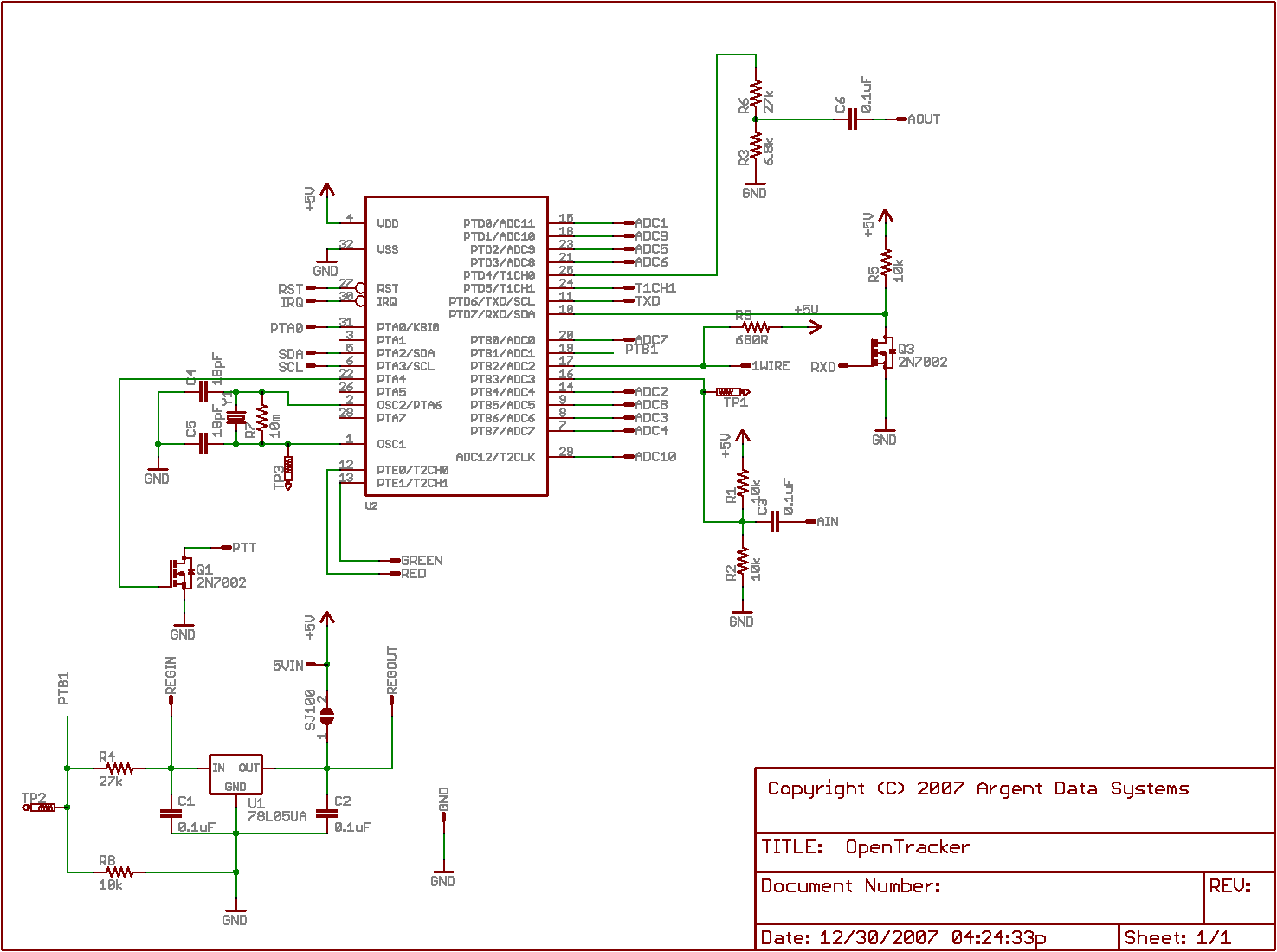

 Copyright © by the contributing authors. All material on this collaboration platform is the property of the contributing authors.
 Ideas, requests, problems regarding Foswiki? Send feedback